
B.Tech Admission at Monad University, Hapur, Uttar Pradesh. Complete Guide 2026–27
Introduction to B.Tech at Monad University
B.Tech Admission at Monad University. The Bachelor of Technology (B.Tech) is an undergraduate engineering degree designed for students who want to build careers in engineering, technology, computing, infrastructure, manufacturing, and other technical industries. The programme combines theoretical knowledge with practical training, laboratory work, projects, and technical problem-solving skills.
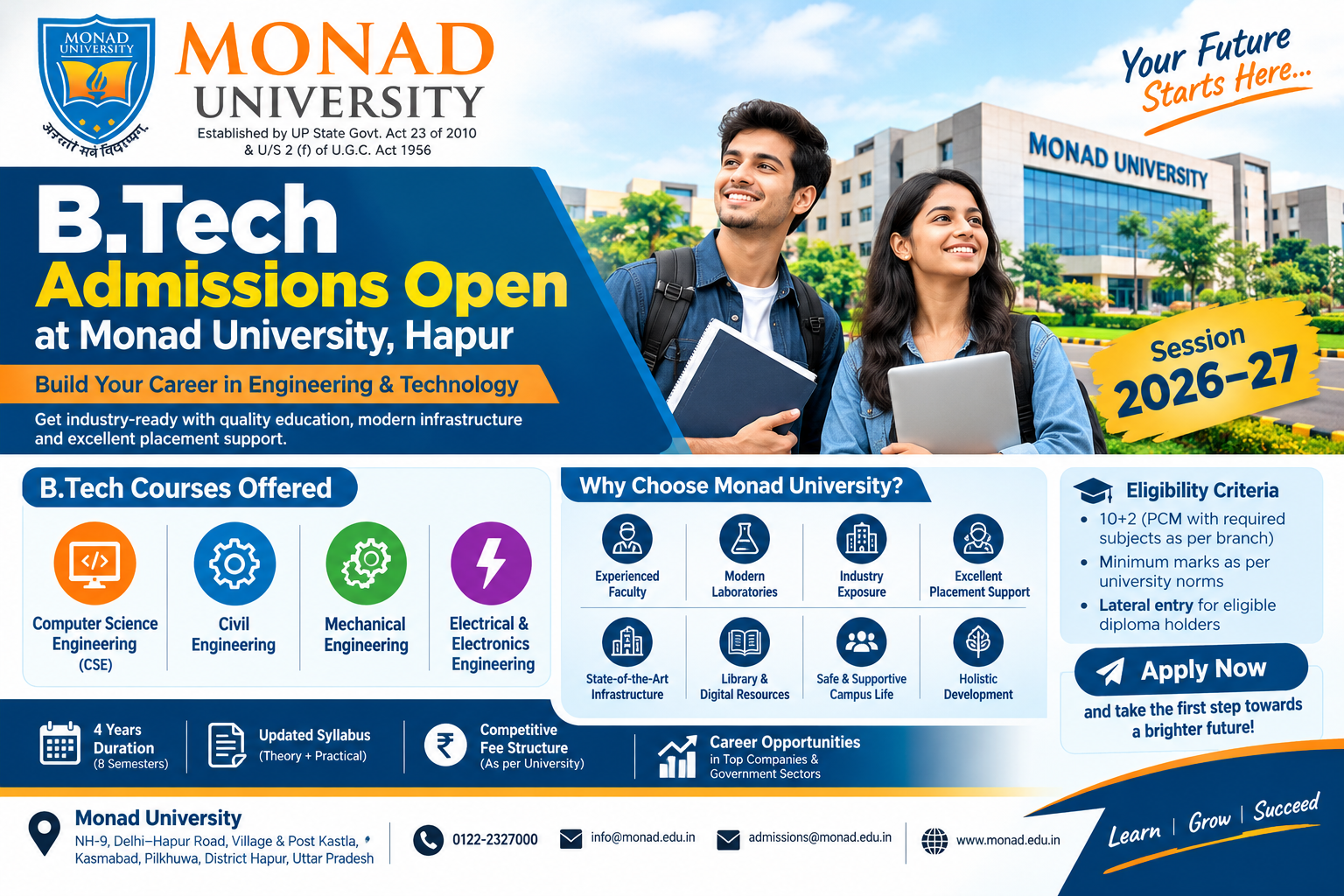
B.Tech. Admission From Monad University, located in Hapur, Uttar Pradesh, offers engineering programmes through its School of Engineering and Technology. According to the university’s official website, its engineering programmes include B.Tech in Civil Engineering, Computer Science, Mechanical Engineering, and Electrical and Electronics Engineering, among other programme listings. The availability of a particular specialisation should be confirmed for the admission session before applying.
Monad University is situated on NH-9, Delhi–Hapur Road, at Village and Post Kastla, Kasmabad, Pilkhuwa, District Hapur, Uttar Pradesh. Students interested in pursuing engineering can explore the university’s programme options, eligibility requirements, admission procedure, fee structure, and academic curriculum before making their decision.
Official website: https://www.monad.edu.in/
1. B.Tech Admission Courses and Specialisations at Monad University
B.Tech Admission From Monad University students generally choose a specialisation based on their academic interests, career plans, and preferred industry. The engineering programmes listed by Monad University include the following options:
B.Tech Computer Science Engineering (CSE): This specialisation focuses on computer programming, software development, algorithms, databases, computer networks, operating systems, and emerging technologies. It is suitable for students interested in software engineering, IT services, application development, and computing-related careers.
B.Tech Civil Engineering: Civil engineering deals with the planning, design, construction, and maintenance of buildings, roads, bridges, dams, and other infrastructure. Students study structural engineering, construction materials, surveying, geotechnical engineering, and transportation engineering.
B.Tech Mechanical Engineering: Mechanical engineering covers machines, manufacturing systems, thermodynamics, engineering design, materials, and industrial production. It can lead to opportunities in manufacturing, automotive engineering, production, maintenance, and quality control.
B.Tech Electrical and Electronics Engineering: This branch focuses on electrical circuits, electrical machines, power systems, electronics, control systems, and electrical equipment. Career opportunities may include electrical maintenance, power distribution, industrial automation, and electrical design.
The university also lists lateral-entry options for certain engineering programmes. Applicants should verify which branches are available for the 2026–27 academic session, along with the approved intake, eligibility requirements, and applicable admission rules.
2. B.Tech Admission Eligibility Criteria at Monad University
Students must meet the university’s prescribed eligibility criteria for the chosen engineering programme. The exact requirements may vary according to the specialisation, admission category, and applicable regulations.
For first-year B.Tech admission, applicants generally need to have passed Class 12 or an equivalent examination from a recognised board, with Physics and Mathematics and the other subjects prescribed for the relevant engineering branch.
For many conventional B.Tech programmes, Chemistry or another approved technical or vocational subject may be required alongside Physics and Mathematics. Students should confirm the precise subject combination accepted by Monad University for their selected specialisation.
Minimum Marks
Applicants should check the minimum aggregate marks required by the university and any applicable regulatory requirements. Do not assume that the same percentage applies to every category or engineering branch.
Students who have completed Class 12 but are awaiting their final results should ask the admissions office whether provisional applications are accepted and what conditions apply.
Lateral Entry Eligibility
Candidates holding a relevant engineering diploma may be eligible to apply for lateral entry into the second year of an eligible B.Tech programme, subject to the university’s rules and applicable regulations.
Eligibility can depend on the diploma discipline, recognition of the awarding institution, minimum marks, branch compatibility, and the availability of lateral-entry seats. Admission to the second year is not automatic merely because an applicant holds a diploma.
Documents Required
Students should prepare the following documents, as applicable:
- Class 10 marksheet and certificate.
- Class 12 marksheet and certificate.
- Engineering diploma marksheets and certificate for lateral-entry applicants.
- Transfer Certificate (TC).
- Migration Certificate, where required.
- Character Certificate.
- Aadhaar card or another accepted identity document.
- Recent passport-size photographs.
- Category certificate, if applicable.
- Entrance examination scorecard, if required.
- Any additional documents specified by the university.
Original documents may be required for verification. Applicants should carry both originals and photocopies when visiting the admission office.
3. B.Tech Admission Process at Monad University, Hapur
The admission process involves selecting a course, submitting an application, verifying eligibility, completing document verification, and paying the applicable fees. The university publishes its admission procedure on its official website.
Step 1: Select Your Engineering Branch
First, decide which engineering specialisation matches your academic background and career interests. Compare Computer Science, Civil, Mechanical, and Electrical and Electronics Engineering, and ask the university which programmes are currently accepting applications for 2026–27.
Students should also confirm whether they are applying for first-year admission or lateral entry.
Step 2: Check Eligibility
Review the academic qualification, subject combination, minimum marks, and other conditions for the selected branch. Lateral-entry applicants should verify whether their diploma discipline is accepted.
If there is any uncertainty about eligibility, obtain confirmation from the university before paying an application or registration fee.
Step 3: Visit the Official Website
Visit https://www.monad.edu.in/ and open the admission section. The university provides an online admission facility and information about its admission procedure.
Read the current admission instructions carefully. Check the course name, academic session, application requirements, payment instructions, and list of documents.
Step 4: Complete the Application Form
Fill in the required details, including your name, contact information, educational qualifications, preferred engineering branch, and other requested information.
Ensure that the details match your official documents. Incorrect personal information, marks, or qualification details can delay verification.
Step 5: Submit the Required Documents
Upload or submit the documents specified by the university. These may include academic certificates, identity proof, photographs, and relevant entrance examination or diploma records.
The university will determine whether the submitted documents and qualifications satisfy the requirements for the selected programme.
Step 6: Complete the Selection or Admission Assessment
Monad University’s admission rules state that selection procedures may vary by course. Students should ask the admissions office whether their chosen B.Tech programme requires an entrance examination, merit-based selection, counselling, an interview, or another assessment.
Do not assume that admission is guaranteed solely on submitting an application.
Step 7: Receive Admission Confirmation
After eligibility and document verification, follow the university’s instructions regarding admission approval, registration, and fee payment.
Before paying, request written confirmation of the course, academic session, total fee, payment schedule, and refund conditions.
Step 8: Pay the Applicable Fees
Pay tuition and other charges only through a payment method verified through the official university website or admissions office. Retain the receipt and transaction reference for your records.
The university’s published general admission procedure contains specific application-payment instructions. Applicants should verify the current amount and payment method applicable to B.Tech admission before making any payment.
Step 9: Complete Enrolment and Attend Classes
After admission is confirmed, complete the remaining enrolment formalities and collect your student identification details and academic schedule. Attend orientation and laboratory sessions, and follow the university’s attendance, examination, and academic regulations.
Official admission procedure: https://www.monad.edu.in/admission-procedure
4. B.Tech Course Duration
The regular B.Tech programme generally has a duration of four years, divided into eight semesters. Each semester includes a combination of classroom teaching, laboratory practicals, assignments, examinations, and project work.
The usual structure is:
- First year: Fundamental sciences, mathematics, engineering basics, and introductory technical subjects.
- Second year: Core engineering subjects and branch-specific foundations.
- Third year: Advanced technical subjects, laboratory work, electives, and projects.
- Fourth year: Specialised subjects, major project work, industrial exposure, and preparation for professional careers.
Students admitted through an approved lateral-entry route may complete the degree in a shorter period, commonly three years after a relevant diploma, subject to the programme structure and applicable rules.
The actual semester calendar, examination schedule, and maximum permitted completion period should be checked with the university.
5. B.Tech Syllabus and Subjects
The B.Tech syllabus depends on the selected engineering branch. The following outlines represent typical subjects taught in engineering programmes. They are intended as a general academic guide and should not be treated as the university’s official semester-wise syllabus.
First-Year B.Tech Subjects
Students across many engineering branches study foundational subjects such as:
- Engineering Mathematics.
- Engineering Physics.
- Engineering Chemistry, where applicable.
- Basic Electrical Engineering.
- Engineering Mechanics.
- Programming Fundamentals.
- Engineering Graphics and Drawing.
- Communication Skills.
- Environmental Studies.
- Workshop Practice.
- Engineering Physics and Chemistry Laboratories.
- Basic Computing and Practical Sessions.
These subjects develop the mathematical, scientific, communication, and practical skills needed for advanced engineering study.
B.Tech Computer Science Engineering Subjects
Computer Science students typically study:
- Programming in C or another introductory language.
- Data Structures and Algorithms.
- Object-Oriented Programming.
- Database Management Systems.
- Computer Organisation and Architecture.
- Operating Systems.
- Computer Networks.
- Software Engineering.
- Theory of Computation.
- Web Technologies.
- Artificial Intelligence and Machine Learning.
- Cloud Computing or Cybersecurity electives.
- Software Development Projects.
Practical laboratory work helps students develop coding, debugging, testing, and application-development skills.
B.Tech Civil Engineering Subjects
Civil Engineering students commonly study:
- Engineering Surveying.
- Building Materials and Construction.
- Strength of Materials.
- Structural Analysis.
- Fluid Mechanics.
- Geotechnical Engineering.
- Concrete Technology.
- Reinforced Cement Concrete Design.
- Transportation Engineering.
- Environmental Engineering.
- Water Resources Engineering.
- Estimation and Costing.
- Construction Management.
Fieldwork, surveying exercises, design calculations, and construction-related projects are important components of the discipline.
B.Tech Mechanical Engineering Subjects
Mechanical Engineering typically includes:
- Engineering Mechanics.
- Thermodynamics.
- Manufacturing Processes.
- Material Science and Engineering.
- Strength of Materials.
- Fluid Mechanics.
- Machine Design.
- Theory of Machines.
- Heat Transfer.
- Industrial Engineering.
- CAD/CAM.
- Production and Manufacturing Technology.
- Quality Control and Maintenance.
Laboratory work may involve manufacturing processes, material testing, thermal systems, and machine design.
B.Tech Electrical and Electronics Engineering Subjects
Students commonly study:
- Circuit Theory.
- Electrical Machines.
- Electronic Devices and Circuits.
- Electromagnetic Fields.
- Power Systems.
- Control Systems.
- Power Electronics.
- Electrical Measurements and Instrumentation.
- Digital Electronics.
- Electrical Drives.
- Switchgear and Protection.
- Renewable Energy Systems.
- Industrial Automation.
These subjects help students understand electrical equipment, power generation and distribution, control technologies, and industrial electrical systems.
Practical Training and Projects
Engineering education extends beyond textbooks. Students generally undertake laboratory experiments, technical assignments, mini-projects, seminars, and a final-year project. Depending on the programme, industrial visits, internships, workshops, and software-based simulations may also be included.
Students should download or request the current official syllabus from the university to confirm the exact subjects, credits, practical requirements, electives, and examination pattern.
Official website: https://www.monad.edu.in/
6. B.Tech Fees at Monad University, Hapur
The total cost of a B.Tech degree depends on the engineering branch, admission category, applicable university charges, and the fee schedule for the academic session. Students planning to enrol in 2026–27 should obtain the latest official fee structure before completing admission.
The fee components may include:
Fee component | Description |
Tuition fee | Charges for academic instruction and coursework |
Registration fee | Charges associated with student registration |
Examination fee | Charges for semester examinations, as applicable |
Laboratory fee | Applicable practical and laboratory charges |
Hostel fee | Accommodation charges for students opting for university housing |
Other charges | Any additional charges specified in the official fee schedule |
What is the B.Tech fee at Monad University?
A verified, current B.Tech fee amount was not available in the official information reviewed for this guide. Therefore, students should not rely on unofficial fee estimates or assume that all engineering branches have identical fees.
To obtain the exact amount, contact the university and request a written fee quotation covering all four years. Ask whether the fee is payable annually or semester-wise and whether examination, registration, laboratory, hostel, transport, or other charges are included.
Students should also ask about scholarships, instalment facilities, applicable concessions, late-payment charges, and the official refund policy.
7. Scope After B.Tech
A B.Tech degree can open opportunities in private companies, public-sector organisations, manufacturing industries, technology firms, construction businesses, research organisations, and entrepreneurship. Career prospects depend on the student’s specialisation, technical knowledge, practical experience, communication skills, and employer requirements.
Career Opportunities After B.Tech CSE
Computer Science graduates can explore positions such as:
- Software Developer.
- Web Developer.
- Application Developer.
- Data Analyst.
- Software Tester.
- IT Support Engineer.
- Junior Cybersecurity Analyst.
- Cloud Support Associate.
Students can improve their employment prospects by developing programming skills, completing projects, learning current technologies, and building a portfolio.
Career Opportunities After B.Tech Civil Engineering
Civil Engineering graduates may explore roles such as:
- Site Engineer.
- Junior Civil Engineer.
- Construction Engineer.
- Structural Design Trainee.
- Quantity Surveyor.
- Estimation Engineer.
- Quality Control Engineer.
- Planning Engineer.
Knowledge of construction practices, technical drawings, estimation, surveying, and industry software can support career development.
Career Opportunities After B.Tech Mechanical Engineering
Mechanical Engineering graduates can pursue opportunities in:
- Production Engineering.
- Manufacturing Engineering.
- Quality Assurance.
- Maintenance Engineering.
- CAD Design.
- Automotive Engineering.
- Industrial Operations.
- Mechanical Design.
Practical experience with design software, manufacturing systems, and quality-control methods can be useful in these roles.
Career Opportunities After B.Tech Electrical and Electronics Engineering
Possible career paths include:
- Electrical Engineer.
- Electrical Maintenance Engineer.
- Power Systems Trainee.
- Electrical Design Engineer.
- Automation Engineer.
- Instrumentation Engineer.
- Electrical Quality Inspector.
- Renewable Energy Technician or Engineer, depending on qualifications.
Candidates should check the technical requirements for each role and develop relevant practical skills.
8. Higher Education After B.Tech
Students who wish to continue studying after graduation have several options, depending on their academic performance and interests.
M.Tech: A postgraduate engineering programme for students seeking deeper technical knowledge or specialisation.
MBA: A management degree for students interested in business administration, operations, project management, marketing, or technology management.
M.Sc. or other specialised programmes: Certain related programmes may be available depending on the subject, admission rules, and eligibility requirements.
Competitive examinations: Eligible graduates can explore relevant government recruitment examinations, engineering-related technical examinations, and other competitive opportunities.
Research and development: Students interested in advanced technical research can investigate postgraduate research pathways and the eligibility requirements of the institutions offering them.
Some postgraduate programmes and competitive examinations have specific subject, marks, examination, or professional eligibility requirements. Students should check the relevant admission notification before applying.
9. Why Consider Monad University for B.Tech?
Students comparing engineering colleges should evaluate academic facilities, faculty, laboratories, curriculum, student support, and career development opportunities.
Monad University’s official website describes its School of Engineering and Technology as offering programmes in several engineering disciplines. The university also describes campus academic facilities, laboratories, classrooms, and library resources.
Before selecting the university, prospective students should consider the following factors:
- Programme availability: Confirm that your preferred engineering branch is offered for 2026–27.
- Academic facilities: Ask to inspect the relevant engineering laboratories and equipment.
- Faculty: Review the qualifications and experience of the faculty teaching your chosen branch.
- Practical learning: Ask about laboratory schedules, workshops, projects, internships, and industrial exposure.
- Placement support: Request recent, branch-wise placement information, including the number of eligible students placed and the employers involved.
- Total cost: Compare the complete programme fee rather than tuition alone.
- Recognition and approval: Verify the university’s legal status and any programme-specific approval or regulatory requirements applicable to your intended course and graduating batch.
Do not make an admission decision based solely on advertising claims. Visit the campus if possible and obtain clear answers to your questions before paying fees.
10. Frequently Asked Questions (FAQs)
Q1. Is B.Tech available at Monad University, Hapur?
The university’s official website lists several B.Tech programmes, including Civil Engineering, Computer Science, Mechanical Engineering, and Electrical and Electronics Engineering. Confirm the availability of your preferred branch for the 2026–27 session directly with the university.
Q2. What is the eligibility for B.Tech admission at Monad University?
Generally, candidates need to pass Class 12 or an equivalent examination with Physics, Mathematics, and the other prescribed subjects for their chosen engineering branch. The university’s specific minimum marks and subject requirements should be confirmed before applying.
Q3. What is the duration of the B.Tech course?
A regular B.Tech degree generally takes four years, divided into eight semesters. Eligible lateral-entry students may complete the degree in approximately three years, subject to the university’s rules.
Q4. What is the admission process for B.Tech at Monad University?
The general process involves selecting a branch, checking eligibility, completing the application, submitting academic documents, fulfilling any applicable selection requirements, paying the prescribed fees, and completing enrolment after admission confirmation.
Q5. Is an entrance examination compulsory for B.Tech admission?
The applicable selection procedure must be confirmed for the specific programme and admission session. Ask the university whether admission is based on academic merit, an entrance examination, counselling, or another prescribed process.
Q6. What is the B.Tech fee at Monad University?
The exact current fee should be obtained from the university’s official admissions office. Request the tuition fee and a complete breakdown of registration, examination, laboratory, hostel, and other applicable charges.
Q7. Can diploma holders apply for B.Tech lateral entry?
Eligible diploma holders may apply for lateral entry where the relevant programme and seats are available. Admission depends on the diploma discipline, marks, recognition of the qualification, and applicable university and regulatory rules.
Q8. Which B.Tech branch is best for career opportunities?
There is no single best branch for every student. Computer Science may suit students interested in software and IT; Civil Engineering may suit those interested in infrastructure; Mechanical Engineering may suit those interested in manufacturing and machines; and Electrical and Electronics Engineering may suit those interested in power systems, electrical equipment, and automation.
The best option depends on your interests, abilities, and long-term goals.
Q9. What documents are required for admission?
Commonly required documents include Class 10 and Class 12 certificates and marksheets, identity proof, photographs, a transfer certificate, a migration certificate where applicable, and additional documents specified by the university. Diploma holders applying for lateral entry should also provide their diploma records.
Q10. Is B.Tech available through distance education at Monad University?
Do not assume that B.Tech is available through distance learning. Engineering programmes involving practical and laboratory requirements must comply with the applicable regulatory framework. The university’s published FAQ states that it does not offer programmes through distance learning. Applicants should confirm the current delivery mode and campus requirements directly with the university.
Q11. What can I do after completing B.Tech?
Graduates can apply for suitable engineering and technical jobs, prepare for eligible competitive examinations, pursue postgraduate study, or establish a technical business. Career outcomes depend on qualifications, skills, experience, and employer requirements.
Q12. How can I contact Monad University for admission?
Visit the official website at https://www.monad.edu.in/ and use its admission section for current application instructions and contact information.
The university’s website lists the following general contact details:
- Address: NH-9, Delhi–Hapur Road, Village and Post Kastla, Kasmabad, Pilkhuwa, District Hapur, Uttar Pradesh, India.
- Email: info@monad.edu.in
- Admissions email: admissions@monad.edu.in
- Telephone: 0122-2327000
Confirm the current contact details and office hours on the official website before visiting.
Conclusion
B.Tech at Monad University, Hapur, may be an option for students looking to pursue engineering in Uttar Pradesh. The university lists several engineering disciplines, including Computer Science, Civil, Mechanical, and Electrical and Electronics Engineering.
Before applying for the 2026–27 session, candidates should carefully check the eligibility criteria, available specialisations, admission and selection procedure, official syllabus, complete fee structure, and applicable recognition or approval requirements. They should also investigate laboratory facilities, internship opportunities, placement outcomes, and the total cost of education.
For the most reliable information, consult the university’s official website and admissions office rather than relying on unverified claims. A careful comparison of course content, expenses, facilities, and career goals will help students make an informed decision about their engineering education.
Official resources
- University website: https://www.monad.edu.in/
- Admission procedure: https://www.monad.edu.in/admission-procedure
- School of Engineering and Technology: https://monad.edu.in/schools/school-of-engineering